The Hidden Costs of Owning an Appliance
And Where to Look on an Appliance to Make an Informed Cost Decision
Greg
6/2/20265 min read


Making an informed appliance buying decision often starts with first impressions and the basic look and feel of a piece in a store or online. That part matters, but a closer look at the information included with the appliance can have a much larger impact on your long‑term satisfaction, especially when it affects your wallet.
Ownership costs are more accessible than most people expect. Much of what you need is already included with the appliance you are considering. Labels, materials, and design choices all point to how the machine is built and what it may cost you over time. Additional research or guidance from an expert, including articles like this one, only strengthens your ability to make a decision that goes beyond the polished store display.
What You Can Find on the Appliance Itself
Appliances on display in a store or online are required to share critical operating and energy use information for shoppers in the United States and Canada. Much of this information is standardized, and the U.S. Department of Energy explains that these labels are designed to help consumers compare models, understand expected energy use, and estimate yearly operating cost. This means you already have access to meaningful ownership cost signals before you read a single review.
For this article, we will focus on the U.S. EnergyGuide. According to the Department of Energy’s Energy Saver guidance, the EnergyGuide label provides three core pieces of information:
Estimated yearly energy cost
Estimated yearly electricity use in kilowatt hours
A comparison range showing how the model performs against similar units
This label is the yellow version used in the United States or the white version used in Canada, and you will usually find it inside the refrigerator you are examining or included in the owner’s manual packet.
Together, we will walk through the guide for LG’s LRFS28XBS, a 27.9 cubic foot French-door refrigerator. The EnergyGuide label for this model provides a clear illustration of how the standardized information is presented and how you can interpret it when comparing refrigerators.
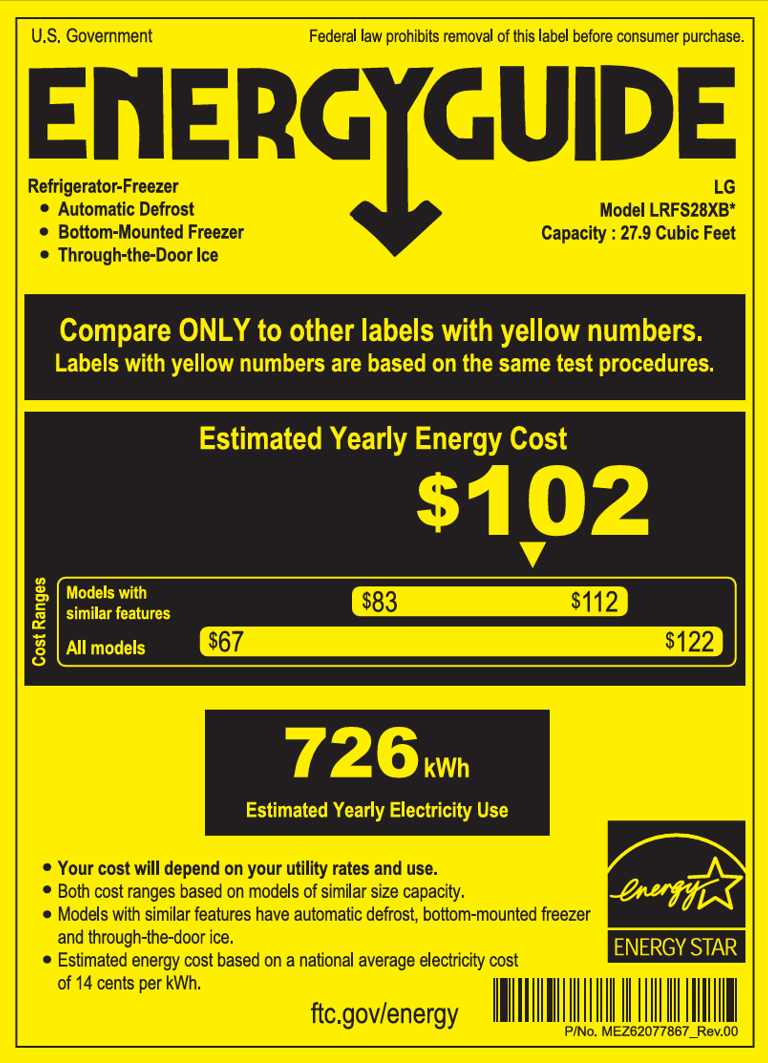
In this example, you can see how, under the assumptions used by the Department of Energy when creating this label, this refrigerator is expected to use about $102 of electricity per year through the consumption of 726 kilowatt hours. These two numbers appear in the center of the sheet in the largest type, since they are the primary comparison points for shoppers. Above them, you will find the product information that identifies which unit the label applies to. The model number is located toward the upper right.
You can now see how straightforward it becomes to compare energy use between models. This LG consumes a certain amount, that Samsung consumes another. These differences become part of the longer-term financial picture of operating the refrigerator.
What Is ENERGY STAR?
ENERGY STAR is a separate federal program run jointly by the Environmental Protection Agency and the Department of Energy. While the EnergyGuide label shows you how much energy a model uses and how it compares to similar units, ENERGY STAR identifies products that meet higher efficiency standards set by the program. A refrigerator with the ENERGY STAR mark has been tested to use less energy than the average model in its category, which can reduce long-term operating cost. This mark can be found on the EnergyGuide of qualifying models in the bottom right.
Long‑Term Cost Realities
In previous articles, we have discussed service and longevity, but not the financial implications that come with them. To do that here, we need to work with a set of assumptions. Some of the available data is well supported and some of it is less reliable, so it is important to understand the limits before using these numbers to guide your own decisions.
Here are the baseline assumptions for this guide:
Most major appliances last between 5 and 10 years. This range is supported by data from JD Power and Consumer Reports.
Slightly fewer than 1 in 10 appliances require an in‑warranty repair in the first year. This figure is consistent across multiple industry sources.
About one‑third of appliances experience a major repair within the first three years. This varies significantly by category and can be higher for refrigerators and washers and lower for ranges and dryers. The data behind this is less consistent, but it aligns with my six years of experience in appliance sales.
A typical out‑of‑pocket repair costs between $200 and $600. This range reflects common service call and parts costs across most brands.
These assumptions are not perfect, but they provide a practical starting point for understanding the long-term financial realities of owning an appliance.
A Hypothetical Cost Scenario for the LRFS28XBS
Using the LRFS28XBS as our example, we can estimate long-term ownership cost by applying the assumptions above. This will not predict the exact experience of every owner, but it will land close to the lived reality for many.
1. Energy use over 10 years The EnergyGuide estimates an annual electricity cost of about $102 or $1020 over ten years.
2. Typical repair cost For this scenario, let’s assume a $300 out of pocket repair. This is close to the cost of repairing or replacing an ice maker, which is one of the most common service calls for French‑door refrigerators. Given our previous assumption on service rates we will include this as highly plausible.
3. Total hypothetical ownership cost Combining these elements gives a simple long-term picture.
Energy over 10 years: about $1020
One major repair: about $300
This results in a rough total of $1320 in operating and service costs over a decade. At the time of writing, the price of this unit was $1699.
4. What this tells you This estimate shows how long-term costs accumulate quietly. The refrigerator may cost over a thousand dollars upfront, but the cost of running and maintaining it over its life can easily add another thousand dollars or more. These costs are rarely discussed when you are standing in front of a polished display model.
Additional Features and Their Impact on Cost
One final consideration is how added features can influence long‑term cost. More features often mean more components, more complexity, and more points where something can fail. Extra lighting, advanced sensors, and smart connectivity all draw additional power, and each added system introduces parts that may require service later. These features can be valuable, but they also contribute to higher operating and potential repair costs over the life of the appliance. Understanding this helps you weigh whether a feature improves your daily use or simply increases the long‑term cost of ownership.
Conclusion
When you buy an appliance, you are committing to more than the price on the tag. You are taking on the years of energy use, the likelihood of repairs, and the added costs that come with extra features and complexity. The good news is that much of what shapes long‑term cost is visible before you make a purchase. The EnergyGuide label, ENERGY STAR certification, and the basic construction of the appliance all provide reliable signals about how the product will perform over time.
By pairing these visible cues with realistic expectations about service rates and repair costs, you can form a clearer picture of what ownership will look like in the years ahead. A refrigerator like the example we used, LG’s LRFS28XBS, may cost $1699 upfront, but the long‑term cost of running and maintaining it can easily add another thousand dollars or more. Understanding this before you buy helps you decide based on the full cost of ownership, not just the moment you bring it home.
Next, we will examine ways you can physically feel build quality in the store and how it may be very similar to shopping for one of your most expensive possessions outside of your home, cars. “Judging Appliance Build Quality: Why the Process Feels a Lot Like Shopping for a Car” coming next month.
Until Then,
Greg
Explore
Discover how appliances enhance your home life.
Inspire
© 2025. All rights reserved.